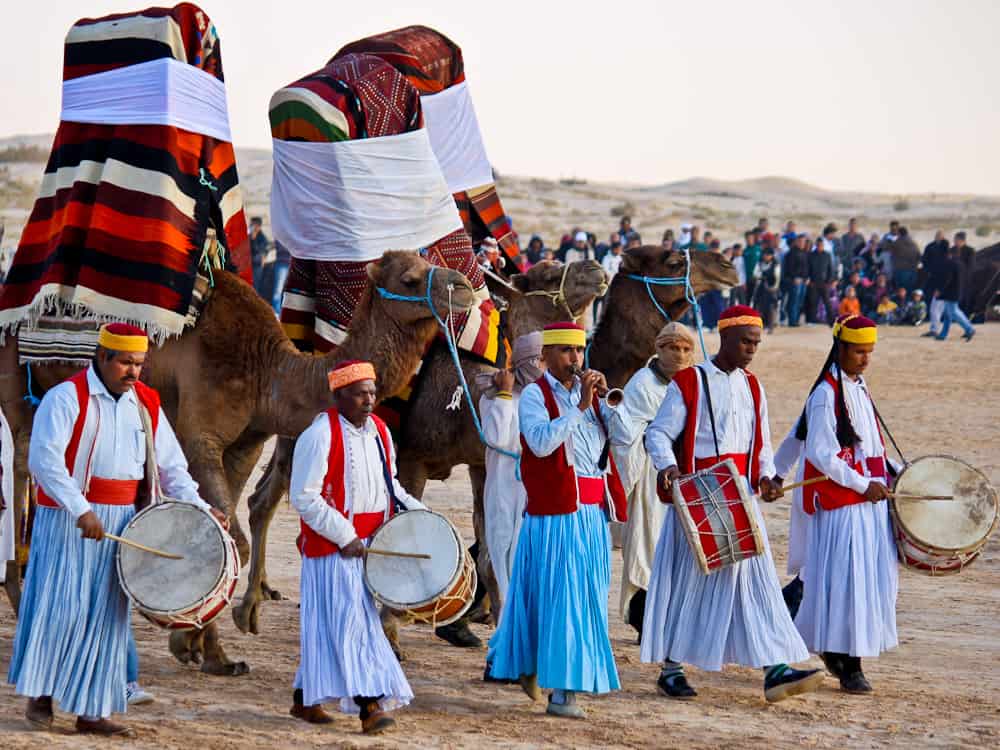
In a time of closing borders, travel bans, and virus scares, the world might seem more closed off than ever. But instead of walling ourselves off, we can discover the rich cultures of northwestern Africa through the fantastic, unique music coming from the region.
From the coast of West Africa to the Mediterranean beaches of Algeria and Morocco, the connection to the Sahara desert brings with it a rich variety of cultures. Ever since the first electric guitar arrived in the region, a blend of musical styles and instruments has led to a unique and original Sahara musical culture.
Below you will find a few of the stand-out artists making waves in the desert.
Tinariwen – Mali Style: Ishumar/ Sahara Blues, Tuareg folk music.
One of the better known examples of the Sahara Blues, Tinariwen is a band from Northern Mali. As a child, founding member Ibrahim Ag Alhabib had built his own guitar and he has never stopped rocking. Tinariwen is a collective of Tuareg men who bring their original version of ancient tribal music through the medium of the typical Tuareg Blues.
Bombino – Niger Style: Blues, Rock, Tuareg
Bombino is another well-known name in North and West Africa. The singer-songwriter from Tidene, Niger, apparently taught himself how to play the guitar before being discovered and then mentored by Haja Bebe, a legend among Tuareg guitarists. Bombino’s songs are infused with political activism and reflect the difficult times his home country has experienced during his lifetime.
Oum – Morocco
Style: Jazz, Soul, Folk, Sufi
Oum El Ghaït Benessahraoui, or simply ‘Oum,’ is another singer-songwriter from Casablanca, Morocco. Originally trained as a gospel singer, Oum can perform a variety of different musical styles and is well known in the Maghreb region. She has produced four albums and has performed at a variety of prestigious events all over the world.
Labess – Algeria Style: Folk, Flamenco, Blues
Labess is an Algerian-Canadian band that performs in Arabic, French, and Spanish. Combining Western and Sahara styles, this band could be considered Sahara fusion at this point.
Sona Jobarteh – Gambia Style: Folk, Kora
Sona Jobarteh is a Gambian singer who plays the kora, a 21-stringed instrument native to West Africa. Sona grew up in the UK but learned to play kora at a young age, performing for the first time as a four-year-old. Practice clearly makes perfect as the summery tones of Sona’s unique music are hard to forget.
Boubacar Traoré – Mali Style: Blues
Boubacar Traoré is a Malinese blues singer who has experienced significant ups and downs throughout his life, moving from fame to obscurity and back. Boubacar’s music is filled with the emotion he has experienced throughout his life.
Africa’s Woodstock Gnaoua World Music Festival
There is really only one place in the world where you could see these acts at their best. The festival is dubbed ‘Africa’s Woodstock’ for its relaxed vibe, great music, and diverse crowds.
Young people from across Morocco hitchhike to the mellow coastal city of Essaouira where traditional Moroccan music meets West African and Caribbean acts. For an unbelievable weekend of unique world music, and a chance to experience the Sahara Blues up close, visit Essaouira during the Gnaoua World Music Festival.
Over the last few months, you must have seen hundreds of mentions of the novel coronavirus, or COVID-19.
The virus is “spreading across the world,” “infecting hundreds,” and now the WHO has classified it as a pandemic.
It sounds scary, that’s true. Coverage over the last month might reminisce of the video-reel shown during the first minute of a post-apocalyptic movie to explain why everyone has suddenly turned into zombies.
Well rest easy, take a deep breath and read on.
Does ‘highly infectious’ mean ‘highly dangerous?’
A common mistake that is made in a lot of media reporting is that something highly infectious must be very dangerous. In fact, there is no relation between the too. Something can not be very infectious but life-threatening, and vice versa.
The fact that the coronavirus is highly infectious means that it spreads easily from person to person, but has no relation to how dangerous it is. In fact, the WHO says that COVID-19 has a 3-4% mortality rate, and the unfortunate people that make up this percentile were mostly older people who already suffered from chronic illnesses.
Am I at risk of contracting the virus?
This comes back to the infectious versus dangerous question. Yes, there is a chance that you might contract the virus. But that does not mean you are going to die, and you might not even feel very sick.
So before you start wearing a hazmat suit or start hiding out in the mountains, please remember: If you are not in a high-risk group, getting coronavirus likely doesn’t mean you are going to die.
I’m young and healthy, why should I care if I get the virus?
It is true that for young people, the virus is not very dangerous. But having the virus means you can spread it to loved ones, or even your local librarian, who may be at an elevated risk of serious or even fatal health complications. In order to make sure you don’t make anyone sick around you, read on to see what to look out for, and if you are symptomatic, visit your doctor.
I’m older and have a chronic condition…
Well, this is the time to ask friends and family to help you do groceries and pick up the medicine you rely on. Make sure to ask them to buy some credit for your mobile phone so that you can call or Skype with loved ones instead of meeting them face-to-face.
Now, read a good book, watch some TV and try to avoid contact with others for a while, and you will have successfully reduced your risk-factor dramatically.
But what about my children?
Ah, children, they look so sweet and fragile, don’t they?
In reality, children are actually quite resilient with their agile immune systems that resist many infectious diseases.
Data from China’s outbreak has shown that children have been nearly untouched by the virus, with many not showing symptoms even when they had contracted the virus. Again, please bring sick children to the doctor for a check-up, if not for them, then for you and others around you.
Children who suffer from asthma do have a disadvantage with COVID-19, as the virus can trigger asthma attacks, but there is no evidence that the virus itself would do much harm outside of the symptoms.
But, I just ordered a dress from China…
There is no reason to believe that Chinese products can carry the disease.
In fact, China is currently sending millions of face-masks and other aid to countries in trouble. Would they do that if there would even be a tiny chance of infection?
While surfaces in public places could, for a time, be contaminated, there is no need to fear that your gadget or t-shirt will make you sick.
What can I do to prevent infection?
Even though COVID-19 is most likely not going to seriously harm you, there is still a need to contain the virus in order to protect those that could be harmed by it.
Wearing a face-mask is not important unless you are a medical professional that deals with COVID-19 cases all day. Wash your hands regularly and properly. Cough in a tissue or your sleeve. Try not to touch your face too much and stay away from people that are unwell.
I’m showing symptoms, what do I do?
Are you feeling feverish? Are you coughing badly or are you short of breath? You might have coronavirus.
Don’t panic. Visit your doctor and in case the virus is detected, bring a laptop or tablet with you. Because now you will have a couple of weeks in quarantine to re-watch Game of Thrones, start learning a new language, or simply soak up all the attention that you will get on social media.
Iran announced that it has requested financial aid from the International Monetary Fund (IMF) to help fight the novel coronavirus (COVID-19) outbreak in the country today, March 12.
The last time Iran borrowed from the IMF was in 1962.
“Our central bank asked for access” to the IMF’s fast-funding instrument, and urged the board of the fund to respond to the request “responsibly,” Iranian Foreign Minister Mohammad Javad Zarif wrote on Twitter.
IMF’s @KGeorgieva has stated that countries affected by #COVID19 will be supported via Rapid Financial Instrument. Our Central Bank requested access to this facility immediately.
IMF/IMF Board should adhere to Fund’s mandate, stand on right side of history & act responsibly.
Meanwhile, Head of the Iranian Central Bank Abdel Nasser Hamati stated on his Instagram account that he, in a letter addressed to the President of the International Monetary Fund, “requested five billion US dollars from an emergency fund” to help Iran reduce the spread of coronavirus.
Iran is the biggest COVID-19 hot spot in the Middle East, with 9,000 confirmed cases and 429 deaths, according to the latest figures.
According to the UN, the number of coronavirus infections outside China has doubled in the past two weeks, and the number of countries hit by the epidemic has tripled.
The World Health Organization (WHO) announced that the global COVID-19 outbreak can now be described as a global pandemic, infecting more than 125,000 people around the world since December 2019.
The global epidemic, however, can be still controlled, assured WHO.
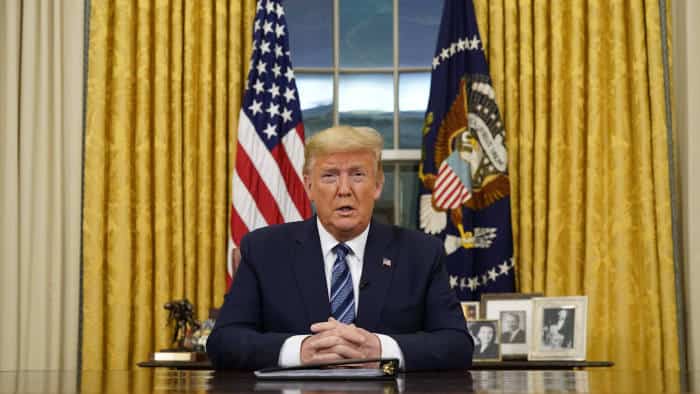
When an American president comes on screen, live from the Oval Office, you can expect those ominous words: “My fellow Americans…”
Commonly used to announce wars or environmental disasters, the eleventh presidential address of the millennium was meant to reassure worried Americans and calm the nerves of global investors.
Bereft of the usual improvisation and off-the-cuff remarks that US President Donald Trump has become known for, the tone was solemn and scripted.
Within 30 seconds, Trump highlighted the global nature of the new coronavirus pandemic and emphasized his administration was “marshaling the full power of the federal power of the national government and private sector,” describing current efforts as “the most aggressive and comprehensive effort to confront a foreign virus in modern history.”
Trump appeared to speak of the virus as a foreign invader, a “threat to our citizens” that can be “ultimately and expeditiously” be “defeated.” Global diseases are a force of nature throughout history, the president continued, “it only matters how you respond.”
After reassuring the public that his often-criticized corona-response was actually done with the greatest “speed and professionalism” by the “best team in the world,” the president listed some of the efforts that had clearly not managed to stop the pandemic from spreading to the US.
In true Trumpian fashion, the president then continued with a dose of ‘whataboutism,’ one of his favorite rhetorical tactics, to emphasize that Europe “failed to take precautions” to restrict travel from “China and other hot-spots,” blaming European travelers for “seeding” new infections in the US.
Markets respond
Trump announced a month-long travel ban on Europe and proceeded to shock markets by stating “these prohibitions will not only apply to the tremendous amount of trade and cargo anything coming from Europe to the US,” which he immediately corrected on Twitter following his speech.
Hoping to get the payroll tax cut approved by both Republicans and Democrats, and please remember, very important for all countries & businesses to know that trade will in no way be affected by the 30-day restriction on travel from Europe. The restriction stops people not goods.
Donald Trump’s address to the Nation was intended to calm moods and reassure Americans that everything was being done to combat the pandemic. Instead, it appears both the public and investors were not impressed.
Tuesday’s mild recovery in stock prices evaporated, as ‘sell’ became the word of the day. TheS&P 500 dramatically lost half of all the market gains realized since Trump’s election in November 2016.
Trump’s blame-game and apparent overconfidence clearly shocked markets who had expected the president to announce a national disaster in order to instantly free up $40 billion for emergency response. Trump is reluctant to do so as he fears it might panic the markets,Politico reports.
Trump’s reluctance has revealed itself to be a miscalculation of epic proportions, as the limited scope of Trump’s proposed measures on the national scale was deemed too little, and the total ban on EU travel deemed excessive.
After Wednesday’s tumultuous market activity, European markets similarly reacted with shock and dismay on Thursday, with no recovery in sight as of mid-day.
On Wednesday, March 11, the Qatar Ministry of Health had a shocking statement for its citizens. Within a single day, reported cases of COVID-19 infections had gone up nearly tenfold, from 24 to 262.
The global pandemic seemed to have a relatively low incidence in Qatar, but in one day it became one of the most infected countries in the Middle East.
Qatar had taken stringent measures to limit the spread of the virus in the small Emirate in the Gulf of Hormuz. Universities and schools were shuttered on Monday, and public events were limited.
Organizers canceled the main event of the Qatar Motorcycle Grand Prix because of the sport’s many links to Italy, and even casual gatherings at shisha bars felt the impact of preventative measures.
The Qatari government had banned travel to 14 countries and efforts to monitor and quarantine suspected cases were in full swing. But it all was to little avail, as Wednesday’s news truly demonstrates the global nature of what the WHO now classifies as a pandemic.
Ministry of Health officials were quick to reassure Qatar’s 3 million residents that all new cases are in quarantine and no further spread is expected.
The source of the current jump in infections, three workers who lived in the same apartment, demonstrates that even a tiny oversight can have a large impact.
The number of people infected is likely to increase among the contacts of announced patients, the Ministry of Health admitted.
Qatar’s relatively young population could provide some relief, as the young are less likely to have life-threatening consequences as a result of infection.
Qatar’s average age of 31.5 is considerably lower than countries like Italy (45.4), raising hopes that Wednesday’s news will not result in an increase in coronavirus-related deaths.
Qatar’s reported number of COVID-19 related deaths still stands at zero.
Acclaimed American actor Tom Hanks announced today, March 12, that he and his wife, Rita Wilson, have been diagnosed with the novel coronavirus (COVID-19) while traveling in Australia.
Hanks was in Gold Coast, Queensland to work with director Baz Luhrmann on pre-production for a film about Elvis Presley, Warner Bros. confirmed.
View this post on Instagram
Hello, folks. Rita and I are down here in Australia. We felt a bit tired, like we had colds, and some body aches. Rita had some chills that came and went. Slight fevers too. To play things right, as is needed in the world right now, we were tested for the Coronavirus, and were found to be positive. Well, now. What to do next? The Medical Officials have protocols that must be followed. We Hanks’ will be tested, observed, and isolated for as long as public health and safety requires. Not much more to it than a one-day-at-a-time approach, no? We’ll keep the world posted and updated. Take care of yourselves! Hanx!
A post shared by Tom Hanks (@tomhanks) on
In a statement posted on social media, Hanks explained that he and his wife had relatively mild symptoms, and would follow the advice of health experts in the coming days.
We felt a bit tired, like we had colds, and some body aches. Rita had some chills that came and went. Slight fevers too,” Hanks wrote. “To play things right, as is needed in the world right now, we were tested for the Coronavirus, and were found to be positive.”
“We Hanks’ will be tested, observed, and isolated for as long as public health and safety requires,” he continued on Instagram. “We’ll keep the world posted and updated. Take care of yourselves!”
Meanwhile, Warner Bros. affirmed they “are working closely with the appropriate Australian health agencies to identify and contact anyone who may have come in direct contact with the individual.”
“The health and safety of our company members is always our top priority, and we are taking precautions to protect everyone who works on our productions around the world,” the statement concluded.
Over recent years, Turkey has maneuvered itself in between NATO and Russia, in moves redolent of geopolitics during the cold war. As the second-largest army in NATO, Turkey was a contributor to the development of the F-35 Lightning II, or Joint Strike Fighter, an advanced fighter-jet that took many years and the collaboration of nine countries to complete.
The jet-fighter uses stealth as its primary tactical advantage and is the most expensive weapons program ever to have been developed in the US. The New York Times reported that production and maintenance are expected to cost American taxpayers more than a trillion dollars over 60 years.
While six of the countries investing in the F-35 have received their first jets, Turkey’s first six jets, worth more than half a billion dollars, were supposed to have been delivered in 2019. Turkey expected a total of 100 F35’s, but the jets remain in storage.
Turkey’s brand new jets are collecting dust at Luke Air Force Base in Arizona because of another weapon system it ordered: The Russian-made S-400 missile system.
The S-400 ‘Triumf’ system is an anti-aircraft system that uses advanced radar combined with multiple intercepting missiles and can defend an area with a radius of 400km, depending on the missiles used.
In contrast, the American alternative, the US Patriot missile system can only fire one missile from a distance of 96km. The system is seen byinternational defense experts as one of the best air defense systems in the world, but it is the system’s ability to detect and destroy stealth fighters that worries the Pentagon the most.
What is the big deal?
The Russian missile system, dubbed the ‘F35 killer’ by Russian arms manufacturers, uses its radar to constantly learn the patterns of planes within its reach. The US military fears that having Turkish F35s integrated into a system that also includes the S-400 would result in the Russian system ‘learning’ about the F35s flying in Turkish airspace.
By analyzing flight patterns and maneuvers the Russian system would in effect negate the US jet-fighters’ stealth capabilities, rendering its tactical abilities useless in the future.
This has made any nation intending to purchase S-400 systems a strategic pariah to the United States, which both India and Saudi Arabia discovered when they made their interest known. Bilateral relations between the US and India have deteriorated and Saudi Arabia is under major pressure to cancel the order of the anti-aircraft system.
As a last-ditch effort to prevent the already installed systems in Turkey from becoming operational in April, the United States has now offered Turkey its Patriot missile system.
Turkey had earlier requested to purchase Patriot missiles to defend its southern border with Syria, a request that was denied. In a significant u-turn, the pentagon is now offering Turkey its missile system in exchange for a promise not to activate its S-400 installations.
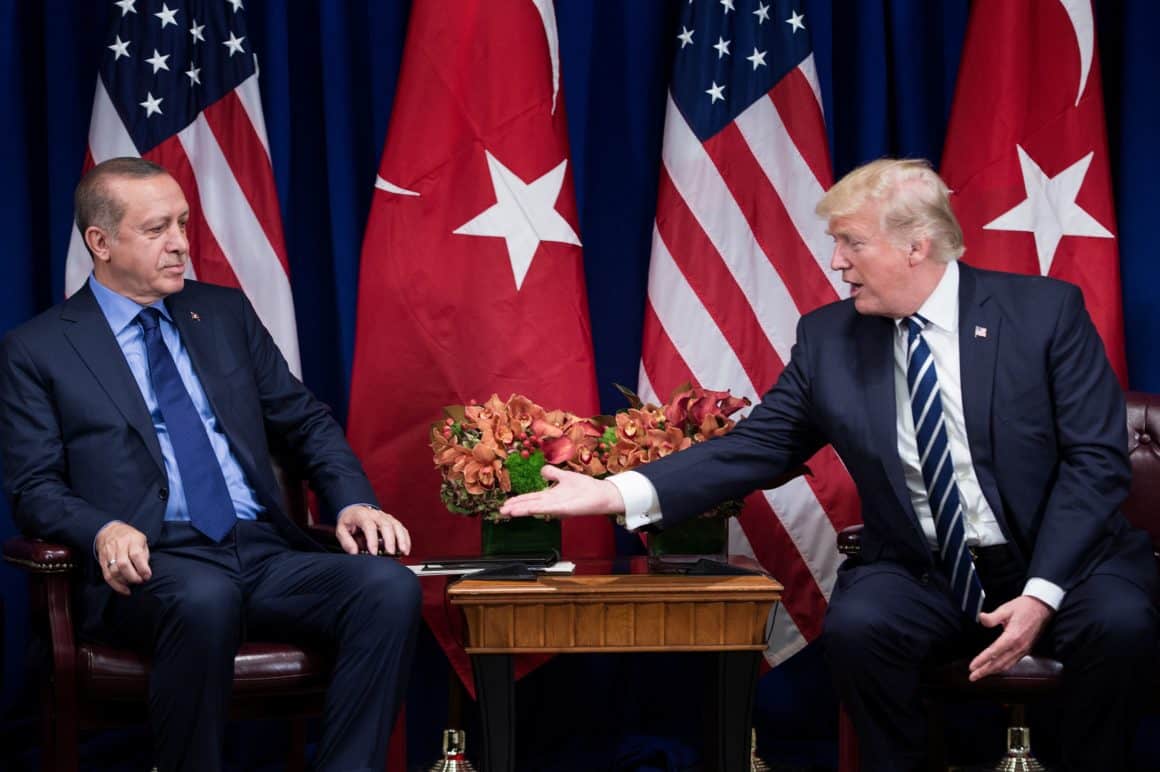
“They also softened significantly on this S-400 issue. They are now at the point of ‘promise us you won’t make the S-400s operational,” Turkish President Tayyip Erdogan told reporters in Brussels.
While Russo-Turkish relations are nowadays commonly seen to hinge on their indirect proxy wars in Libya and Syria, the coming month will show how geopolitical relations between the US, Russia, and Turkey will evolve.
If Turkey activates the S-400 system, its position in NATO, and as an ally to the US, could be in serious jeopardy and a potential realignment of alliances in the Middle East could be in the making.
After years of fighting between Iran-backed Houthi rebels and the Saudi-led alliance, Yemen is gasping for peace.
The conflict has created what the UN calls ‘the worst humanitarian crisis in the world,’ with over 76% of Yemenis in need of humanitarian assistance. Like most wars, the people who suffer the most are the weak and defenseless, innocent civilians, and the poor who are unable to leave the country.
“Women and children make up almost 76 percent of displaced persons in Yemen, and amid all the hardships, women have remained strong and resilient,” according to Nestor Owumohangi of the UNFPA.
“In most cases they have been the ones carrying the burden of providing for their families.”
The NGO International Rescue Committee claims that gender-based violence has increased by 63% while forced and early marriages have tripled since the conflict started, making Yemen the worst-ranked country in the World Economic Forum’s Gender Gap Index.
Because of the economic and security impact the conflict has had, many children have missed years of primary and secondary education, severely hampering their potential for success in the future. The UN estimates that almost half of all Yemeni women are illiterate, a worrying fact that only worsens as girls and young women are unable to get an education in the war-torn nation.
Healthcare is similarly impacted by the fighting, as millions have been internally displaced and hospitals are routinely targeted.
“This is a completely unacceptable breach of international humanitarian law,” Lise Grande, Resident Coordinator and Humanitarian Coordinator for Yemen, argued in astatement.
“It’s terrible that facilities upon which thousands of people depend to survive have been badly damaged. The health sector has been hit very hard during this war: preventing further damage and helping to rebuild it are some of our highest priorities.”
Fighting continues
On Monday, the Saudi-led coalition announced that they had taken control of several towns on Yemen’s northern border with Saudi Arabia. It had taken at least 18 airstrikes before retaking the area, which Houthi militias had moved into only a few days earlier following their conquest of Hazm to the south. Losing and regaining the border towns had cost 35 lives onboth sides, according to the Associated Press.
Now, the coalition forces will move south to attempt to retake Hazm, despite UN Envoy Martin Griffiths warning that doing so would lead “back into large-scale conflict and another humanitarian tragedy.”
“The military adventurism and quest for territorial gains that we have seen since mid-January in northern Yemen are leading us away from peace,” he added.
It is this back-and-forth of losing and regaining territory in the sparsely populated country that brings back memories of the Vietnamese-American War, where a technologically advanced and well-funded foreign coalition tried to gain control over strategic areas, only to have to abandon them to fight elsewhere.
When there is little to gain for all sides, there ought to be room for peace. In the end, only a dialogue between the warring parties, including their international backers, can result in peace through diplomacy. Further deterioration of the worst humanitarian crisis in the world is in nobody’s interest.
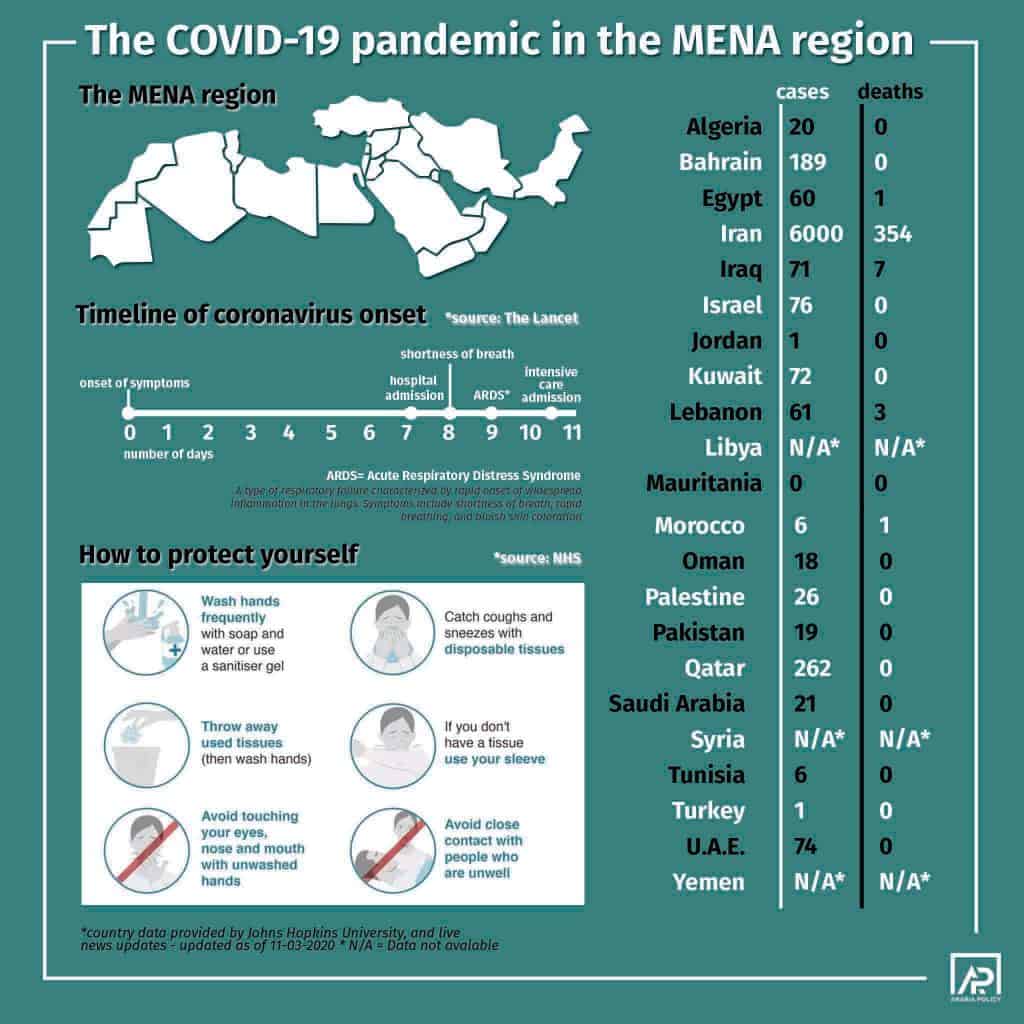
The spread of the COVID-19 pandemic has resulted in 20 cases in Algeria so far.
Because 16 of these 17 cases belonged to a single family, Algerian authorities were hopeful they could contain the spread, since then 3 more cases have been discovered.
On the evening of Sunday, March 8, the Algerian Ministry of Health published new guidelines for hospital directors. The government presented over $3 million in additional funding to fight the spread of the virus on Monday, March 9. The most recent cases have been quarantined in Blida province south of Algiers.
Bahrain
Confirmed cases: 189, Deaths: 0, Recovered: 30
For an island nation as small as Bahrain, 189 cases indicate a very high infection rate.
Bahrain’s close links in trade and travel across the Middle-East have presented the nation with a dilemma. Because of the frequency of travel in and out of the country, Bahrain’s Ministry of Health has asked citizens to return from Lebanon and Egypt to self-isolate.
The government appears to be taking some preventative measures: The Formula One Grand Prix will go on as planned, on Sunday, but without the thousands of fans that usually attend such an event.
Since Monday, March 9, Bahrain’s numbers have more than tripled from 51 to 189, leading Saudi-Arabia to declare a 72-hour window for Saudi nationals to leave Bahrain before Saudi Arabia closes down travel to and from Bahrain.
Egypt
Confirmed cases: 60, Deaths: 1, Recovered: 1
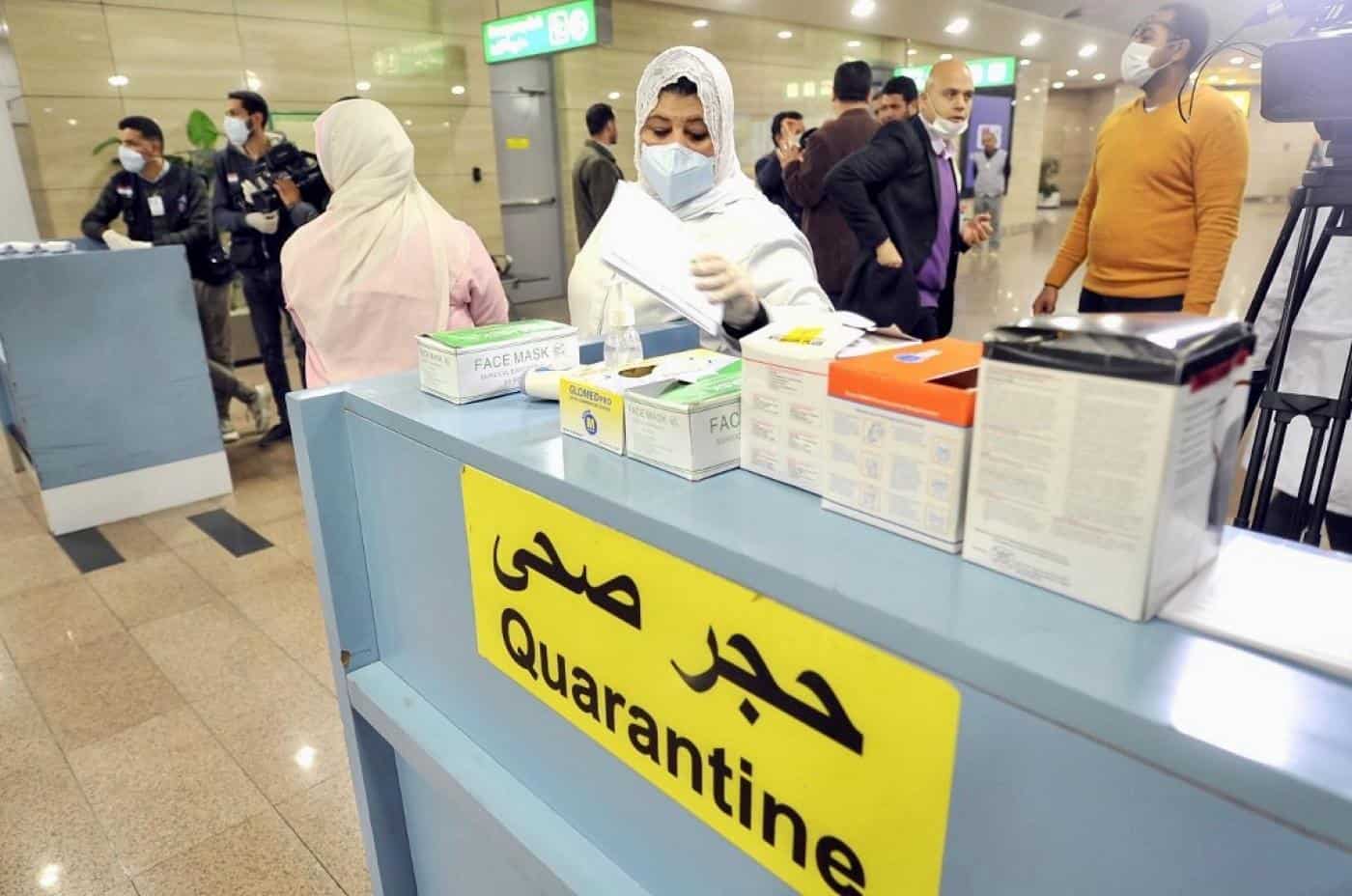
Reported cases are rising rapidly in Egypt, where the death of a 60-year-old German tourist in Hurghada marked the country’s first COVID-19 fatality on March 8.
Taiwan’s first reported case of the virus appears to have originated in Egypt. A Taiwanese woman who had recently visited Egypt as a tourist was diagnosed with the virus.
The number of confirmed COVID-19 cases jumped from three to 45 by Monday, since then the number of reported cases has increased to 60.
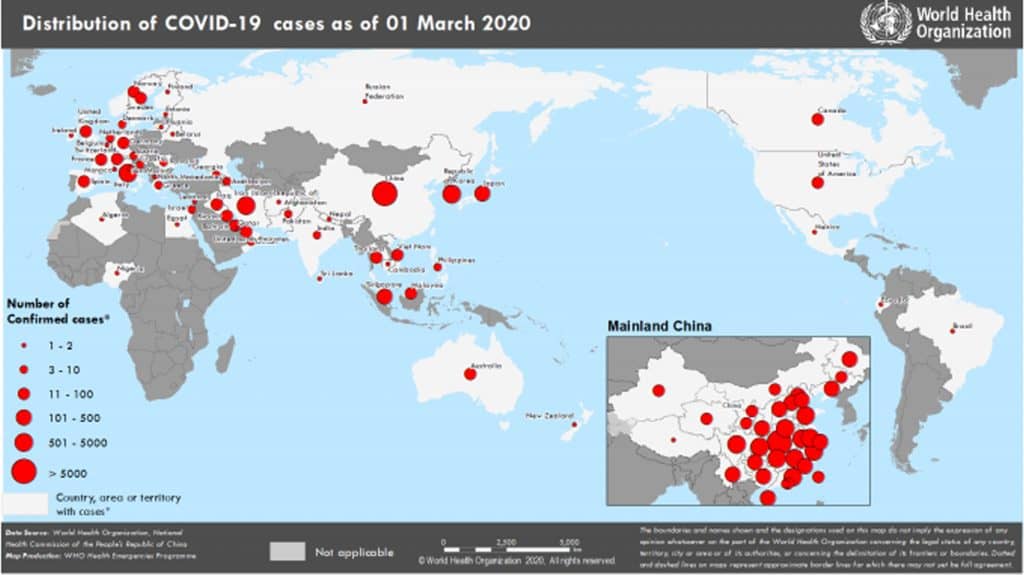
Graphic: Global overview (WHO map, page 1)
Countries, territories or areas with reported confirmed cases of COVID-19, 01 March 2020
With more than 6,000 confirmed infections and 354 reported deaths, Iran appears the worst-hit MENA-country thus far.
The alarming number of infections among politicians and senior health officials indicates that the virus is poorly contained. Reports that two senior politicians have died of COVID-19, as well as indications that the head of Iran’s corona-response, Esmail Najar, has been infected, offer little hope that the virus can be contained within Iran’s borders.
Iraq
Confirmed cases: 71, Deaths: 7, Recovered: 3
Iraq has enough issues to keep its politicians awake at night already—protests against the government have brought the country to a standstill on several occasions and the country’s economic crisis affects every part of society.
Muayyad Al-Alami, president of Iraqi Syndicated Journalists, has sounded the alarm that more trouble is ahead.
Iraq has so far reported dozens of cases, but protesters have refused to abandon public events. On Friday night, protesters in Baghdad were heard singing, “let coronavirus come to Iraq to take revenge at militias and corrupt politicians.”
Footage:
The Iraqi government has so far approved emergency measures to try to stop the spread of COVID-19 in Iraq, including banning Shia pilgrimages to Najaf, as Johns Hopkins data set the number of confirmed cases to 71.
Israel
Confirmed cases: 76, Deaths: 0, Recovered: 4
Now that 76 cases have been reported, Israel is a key country in the Middle-East COVID-19 pandemic.
The Israeli government is now quarantining all visitors from abroad, regardless of their origin.
In Athens, an Israeli diplomat and his family were diagnosed with the virus.
Israel and Jordan have now both closed their borders with the West Bank.
Jordan
Confirmed cases: 1, Deaths: 0, Recovered: 0
The Jordanian government is taking a careful approach, quarantining citizens who have traveled abroad and banning visitors from China, South Korea, Italy, and Iran.
Jordan now has 77 people under quarantine, down from 296 last week. Only one case has been reported and an increasing number of those under quarantine have been cleared.
Kuwait
Confirmed cases: 72, Deaths: 0, Recovered: 2
Kuwait reported three new cases on Monday, March 9, and seven more since. This brings the total number of confirmed cases to 72, according to data provided by Johns Hopkins.
All suspected patients have been brought to a designated hospital for medical observation, with three patients in intensive care, Al-Arabiya reported on Monday. The public does not appear reassured after the Kuwaiti Arab Times reported that an infected person had recently attended a public funeral.
Lebanon
Confirmed cases: 61, Deaths: 3, Recovered: 1
Reuters reports that the country’s shortages of imported goods have not yet hampered the containment, but Lebanon’s close contact with several countries with high infection rates, as well as it’s connection with Iran, indicate that further spread of COVID-19 can be expected. On March 11 Lebanon recorded its second COVID-19 related death, as well as 8 new cases according to Naharnet.
Libya
No data available
In a country with no effective government, an active civil war raging, and close contact with several countries with a relatively high incidence of the virus, it should stand to reason that the virus will have a significant impact on the country if it is not already.
At the end of February, Libya’s Ministry of Health claimed there were no cases of the virus whatsoever, yet it remains to be seen if the Tripoli government could do anything at all to stop the virus given it’s lack of control over the country.
Mauritania
Confirmed cases: 0, Deaths: 0, Recovered: 0
Mauritania has so far remained untouched by the COVID-198 pandemic, according to numbers provided by Johns Hopkins University.
Morocco
Confirmed cases: 6, Deaths: 1, Recovered: 0
On Tuesday, March 10, Morocco confirmed its first death due to the virus, after an 89-year-old woman with chronic condition died in a Quarantined Casablanca intensive care unit.
Both the public and private sectors are taking the virus seriously. All events with more than 1,000 attendees have been canceled and a national campaign is informing citizens how toavoid the risk of contamination.
Morocco World News today reported three new cases on Wednesday, March 11, as the pandemic intensifies worldwide.
Oman
Confirmed cases: 18, Deaths: 0, Recovered: 9
After detecting its 16th case of COVID-19, the government of Oman has decided to suspend all flights from Egypt. How effective the ban will be remains to be seen: two further cases have been reported since the ban was put in place.
Palestine
Confirmed cases: 26, Deaths: 0, Recovered: 0
The Palestinian Authority has declared a state of emergency after the virus has spread from Bethlehem to nearby Nazareth. Major economic hardships are expected as Israel closes borders and the Palestinian hospitality branch appears to be the current source of infection.
Qatar
Confirmed cases: 262, Deaths: 0, Recovered: 0
Similar to Bahrain, Qatar’s small size and international outlook makes it rife for contact with COVID-19 infected individuals. The country has banned travelers from 14 countries and closed all schools and universities.
Qatar recorded 238 new cases in one day, according to the Qatar Ministry of Health.
Pakistan
Confirmed cases: 19, Deaths: 0, Recovered: 1
Pakistan’s close proximity and trade with Iran might result in an increase in the infection-rate in the near future. Pakistan has a lot at stake: The Asian Development Bank estimates the economy might lose $5 billion as a direct result of the virus.
Saudi Arabia
Confirmed cases: 21, Deaths: 0, Recovered: 1
Saudi Arabia has so far reported 21 cases, including four new cases Monday, March 9 and six cases since. The government has suspended travel to and from nine countries, closed schools, and universities, and has put an area home to half a million people under quarantine.
Syria
No data available
With many of its largest cities in rubble and several foreign military forces active within its borders, Syria is wholly unprepared for the inevitable spread of COVID-19. Bordered by countries where the virus has been detected, and working closely with Iran, it is only a matter of time until the scale of the virus in Syria is revealed.
Tunisia
Confirmed cases: 6, Deaths: 0, Recovered: 0
Tunisia has so far reported six definitive cases of the virus. The government has banned flights to Italy and is contemplating potential further travel bans.
Turkey
Confirmed cases: 1, Deaths: 0, Recovered: 0
The Guardian reports that a Turkish citizen, returning from Europe, has been found to carry the COVID-19 virus. The man has been quarantined along with his family.
United Arab Emirates
Confirmed cases: 74, Deaths: 0, Recovered: 12
Like other Gulf countries, the UAE is experiencing a rising number of infections.
The UAE’s position as a global hub for travel has led local airlines to issue waivers to customers now banned from flying. With a two-week vacation starting today, the government has urged teachers, school staff, and students not to travel abroad.
Yemen
No data available
WHO reported last week that no cases have been confirmed as of yet, warning that Yemen is ill-equipped to deal with the inevitable spread of the virus.
The ongoing civil war means little to no containment is possible on a national level in Yemen. Houthi health officials reported to Al-Monitor that 193 Yemenis had recently returned from China and had been tested and released.
*data provided by Johns Hopkins University, updated as of 11-03-2020
UPDATE: COVID-19 Pandemic Continues to Spread Throughout MENA Region -Photo: Arabia Policy
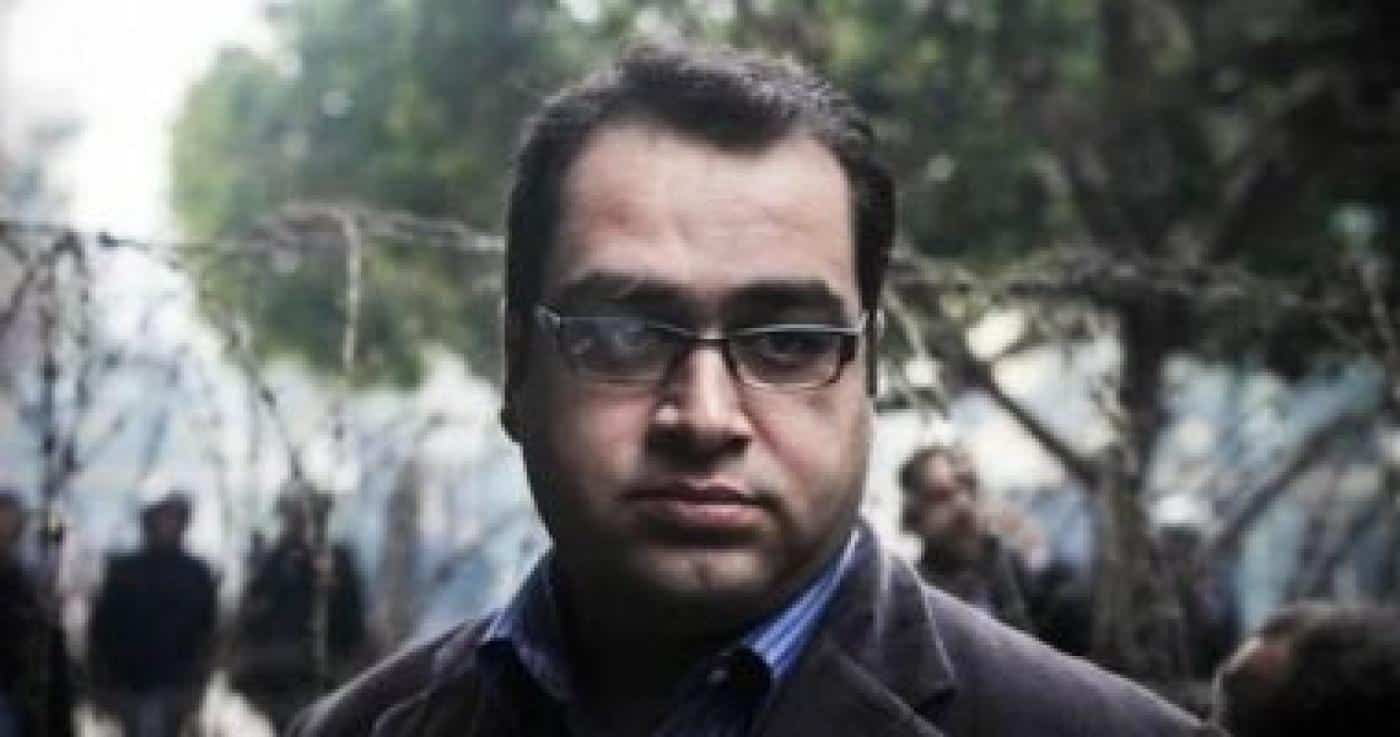
El-Elaimy was found guilty of “spreading false news with an intent to spread panic among the people and disturbing public peace” by the Mokattam Misdemeanour Court, in relation to a 2017 interview with BBC Arabic.
The politician, who served in Egypt’s post-revolution parliament, used the 2017 interview to accuse Egyptian authorities of ‘terrorizing’ political opponents and criticized el-Sissi for his failure to engage with opposition parties.
The Egyptian Social Democratic Party leader and human rights lawyer has been an active critic of President el-Sissi’s regime.
Amnesty International have decried the verdict as politically motivated and said it is part of a broader crackdown on free speech and peaceful political activities in Egypt.
The international human rights group say El-Elaimy has been “unlawfully detained” since June last year over “his peaceful political activities.”
“He has now been sentenced to a year in prison for daring to give a TV interview to BBC Arabic, in which he spoke about the practices of politically motivated imprisonment, enforced disappearance and torture in Egypt,” Amnesty International’s Research and Advocacy Director for the Middle East and North Africa Phillip Luther said.
El-Elaimy appealed the court’s decision and will remain in detention until the next hearing on April 7.
“The unfounded charges of which Zyad has been convicted stem solely from the peaceful expression of his opinion and his peaceful political activities, demonstrating the Egyptian authorities’ total intolerance of dissent. It is outrageous that he has been punished with a year’s imprisonment simply for speaking to the media,” said Luther.
The Associated Press reports the politician and lawyer is facing additional terrorism-related charges, for conspiring with the Muslim Brotherhood and others to form an alliance to contest the 2020 parliamentary elections.
El Elaimy stands accused of “unfounded ‘terrorism’-related offenses, according to Amnesty.